.png)
Wind on the Central Coast: The Towns Where It Matters

Updated: 2 days ago
Every spring we show homes on a bright, warm morning and everything feels perfect. Then the buyer comes back for a second look at four in the afternoon, the flag on the porch is standing straight out, and they ask a question we have heard a hundred times: is it always like this? The answer is no, and also, sort of. Wind on the Central Coast is predictable once you understand it, and it is one of the most important things to know about a town before you buy there.

MARINE AIR · GAPS IN THE HILLS
Why the Central Coast is windy in the first place
The mechanism is simple. Inland valleys heat up during the day; the ocean stays cold. Warm air rises over the interior, cool marine air rushes in to replace it, and every gap in the coastal hills becomes a funnel.
The result is an afternoon onshore wind that builds through spring and summer, usually starting late morning, peaking mid-afternoon, and settling near sunset. Winter brings a different kind: storm winds from the south and southeast ahead of Pacific fronts, and the occasional dry offshore event.
So the question is never "is this town windy" so much as "how exposed is this particular lot to the afternoon onshore flow." Two homes a mile apart can live very different lives.
WHERE THE BREEZE COMES WITH THE ADDRESS
The towns where wind is part of the identity
The Nipomo Mesa and Oceano
This is the windiest inhabited area in the county, and there is no point pretending otherwise. The Mesa sits high, open, and directly in the path of the air coming off the dunes. Afternoon wind is a daily event from spring into early fall, sand travels, and mature trees lean noticeably east.
Homes here are built and landscaped around it: windbreaks of Monterey cypress and eucalyptus, courtyards, and outdoor living tucked on the lee side of the house. We go into the specifics in homes on the Nipomo Mesa: lot sizes, wells, and wind. Oceano, at the foot of the Mesa beside the dunes, gets the same wind at sea level.
Los Osos and Baywood Park
Los Osos faces the mouth of Morro Bay with the sandspit between it and the open ocean, which takes some of the edge off but not all of it. Afternoon wind across the bay is reliable enough that kayakers plan around it. The Baywood side, closer to the water, feels it more; the neighborhoods that climb toward the hills feel it less.

Morro Bay and Cayucos
Morro Bay's waterfront and the north end of town are exposed. Cayucos, with its long open beach facing the northwest, gets a stiff afternoon breeze that makes the mornings the prized part of the day. This is the pattern all along Highway 1: still and often foggy mornings, wind in the afternoon, calm at dusk. It is why locals surf and walk the beach early and why the Morro Bay vs Cayucos comparison reads the way it does.
The Templeton Gap
The Templeton Gap is a well-known break in the coastal range that lets marine air flow inland toward the Salinas Valley. Templeton and the west side of Paso Robles benefit from it enormously: the afternoon breeze knocks the top off the summer heat and is one of the reasons the westside wine country grows what it grows.
The trade-off is that it is a breeze you can feel. Homes on the ridges west of Templeton and along parts of Highway 46 West can be quite windy on summer afternoons, while the east side of Paso, out of the Gap's path, is hotter and stiller. Wine country buyers should read Paso's westside vs eastside: where the line is with wind in mind.
The bluffs of Pismo and Shell Beach
The bluff-top neighborhoods enjoy the views and pay for them in exposure. Sea-facing decks in Shell Beach are glorious at nine in the morning and often unusable at three in the afternoon without a glass windscreen, which is why so many homes there have one.

SHELTERED VALLEYS · INLAND POCKETS
The towns where it mostly does not
San Luis Obispo proper is sheltered by the Morros and the Irish Hills; you get an afternoon breeze, particularly on the south side toward the airport, but rarely the sustained wind of the coast. Arroyo Grande's village and the neighborhoods east of the freeway are calmer than the Mesa a few miles south.
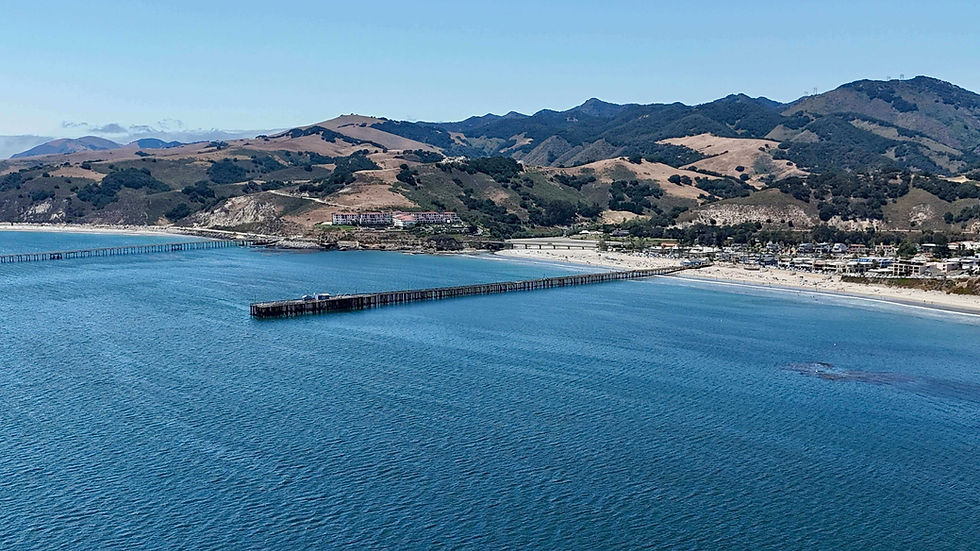
Avila Beach, tucked into its cove facing south, is famously the county's calm and sunny corner. Atascadero, Santa Margarita, Creston, and the east side of Paso are mostly still, with heat as their summer weather story rather than wind. Cambria, in its pines and canyons, is more sheltered than Cayucos despite being further up the coast, though its exposed ridge lots are another matter.
PATIOS · WINDOWS · LANDSCAPING
What wind does to a house and a lot
This is the part that affects your money, not just your afternoon.
Outdoor living. A west-facing patio on the Mesa or in Cayucos may be a morning space, not an evening one. Courtyards, east-facing decks, and windscreens are worth real value in windy towns, and we point them out on tours.
Landscaping. Windbreak trees are an asset and also a maintenance responsibility. Eucalyptus in particular sheds and can fail in storms; ask about the age and condition of any windbreak. Plant selection changes too, and our guide to native plants for SLO County yards leans on species that handle exposure.
Sand and dust. Mesa and Oceano homes deal with fine sand on windowsills and in tracks. Good weatherstripping is not optional.
Roofing and fencing. Wind loosens ridge caps, lifts shingles, and turns a tired fence into a project. Inspectors here look for it.
Solar and gutters. Debris accumulates faster on the windward side.
Fire behavior. Wind is the single biggest factor in how fast a wildfire moves, which is why wind-exposed rural lots carry a different risk profile and why defensible space matters more there.
BEFORE YOU WRITE AN OFFER
How to check before you buy
Visit at the windy hour. Mid-afternoon in spring or early summer tells you the truth. A Saturday morning showing tells you nothing.
Look at the trees. If every tree on the block leans the same direction, that is your answer.
Look at the neighbors' yards. Windscreens, walled patios, and cypress rows are a community's honest statement about the weather.
Ask the seller. Sellers must disclose known material facts, and most are straightforward about wind when asked directly.
Ask us. We know which streets in each town are the exposed ones and which sit in a pocket.
Wind is not a reason to avoid a town. It is a reason to buy the right house in that town.
Your next step
If you have a specific property in mind, tell us the address and we will tell you what its afternoons are like before you drive out. If you are still choosing a town, our town-by-town microclimate guide pairs well with this one, and our property search lets you compare the sheltered and exposed neighborhoods side by side.

Talk With Kim & Kristen
We are Kim San Jule and Kristen Gentry, Broker Associates with Real Broker, serving San Luis Obispo County and the Central Coast. Whether you are buying, selling, or simply thinking ahead, we are glad to be a resource.
Kim San Jule · Broker Associate, DRE 01948144 · 805-345-8303 · kimsanjule@gmail.com
Kristen Gentry · Broker Associate, DRE 01968754 · 805-441-4618 · kristengentryslo@gmail.com
Real Broker · Search Central Coast homes for sale