.png)
Why SLO County Home Prices Hold Up in Downturns

Updated: 2 days ago
Every few years the national conversation turns to whether housing is about to fall, and every few years we get the same question from clients: does that apply to SLO County home prices? You've probably heard, from a neighbor or a relative who has owned on the Central Coast for decades, that San Luis Obispo County "doesn't really go down." That's an overstatement. But there's a real pattern underneath it, and it's worth understanding before you buy or sell.
This post is about the structural reasons SLO County home prices tend to hold up better than most markets when the cycle turns, not a prediction, and not a promise. Markets can and do soften here. The point is that the floor tends to be higher and the recovery tends to be quicker, and there are specific, local reasons why.

THE PACIFIC · THE SANTA LUCIA RANGE · GROWTH BOUNDARIES
Reason one: there is almost nowhere to build
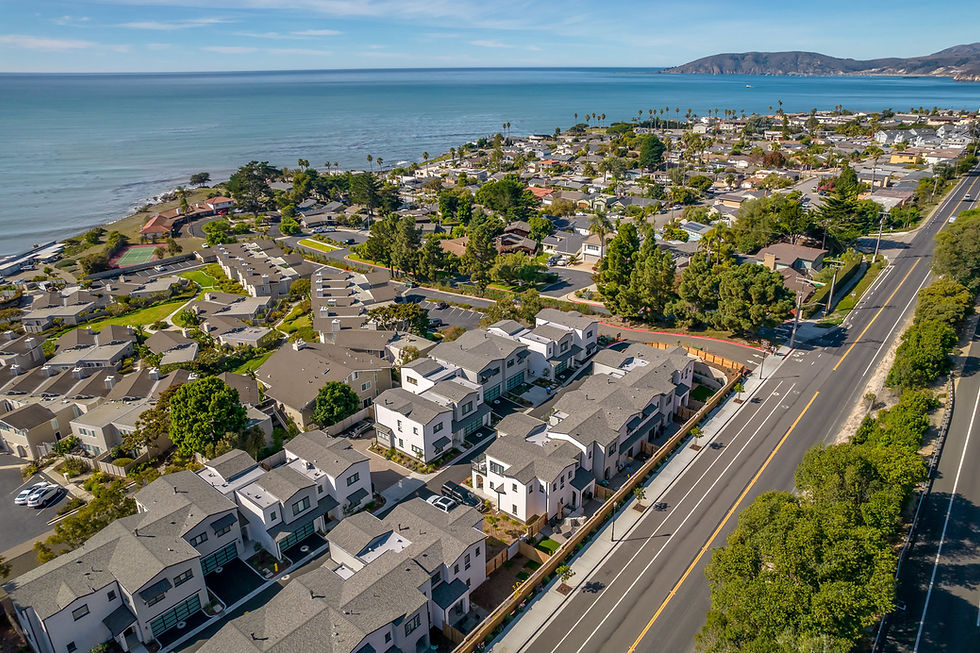
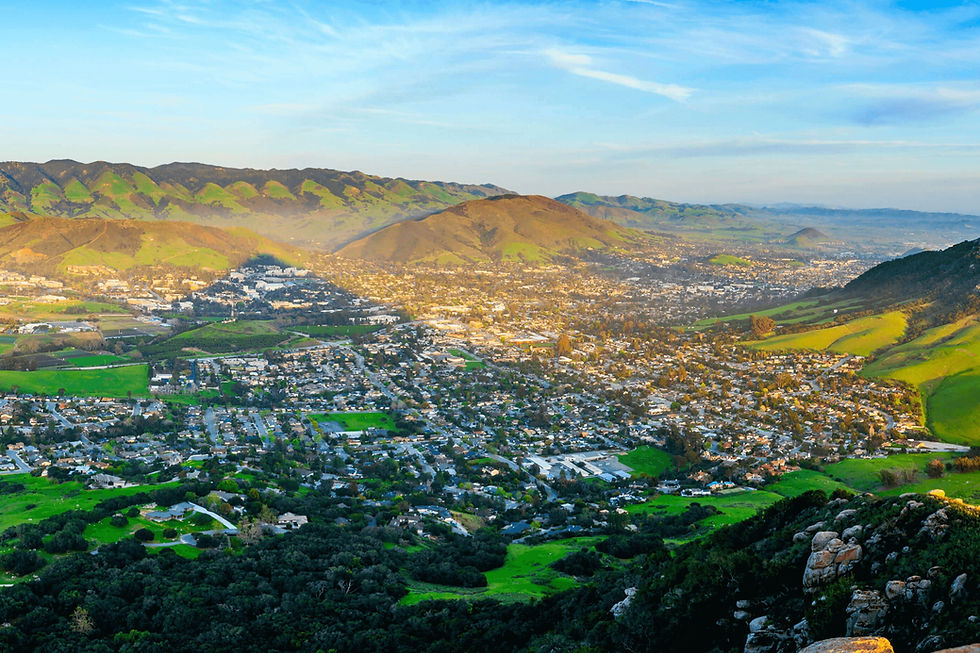
Start with geography. San Luis Obispo County is hemmed in by the Pacific on one side and the Santa Lucia Range on the other, with the Los Padres National Forest, state parks, agricultural preserves, and the Coastal Zone taking huge portions off the table. Most of our cities have voter-approved or policy-driven growth boundaries. Coastal towns west of Highway 1 face additional layers of review that make large new subdivisions close to impossible.
The result is that housing supply grows very slowly. In markets where builders can add thousands of units when prices rise, a downturn combines falling demand with a glut of new inventory, and prices drop hard. Here, a downturn is mostly just falling demand against a supply that barely moved. That's a very different equation.
We wrote about what this means for buyers weighing new subdivisions against older neighborhoods in new construction vs established neighborhoods in SLO County.
CAL POLY · CUESTA · HEALTHCARE · COUNTY GOVERNMENT
Reason two: the demand is diversified and sticky
A one-industry town falls when its industry falls. SLO County's demand comes from an unusual mix of sources that rarely all weaken at the same time:
Cal Poly and Cuesta College, which bring faculty, staff, students, and parents who buy housing regardless of the national economy. We go deeper on this in the Cal Poly effect on SLO housing.
Healthcare and county government, which are steady employers concentrated in and around San Luis Obispo.
Vandenberg Space Force Base to the south, which sends a steady stream of relocating families into Nipomo, Arroyo Grande, and the Five Cities.
Retirees and second-home owners from the Bay Area and Southern California, who are often buying with equity rather than borrowing, and who tend to hold through cycles.
Agriculture and wine, which anchor North County and the Edna and Arroyo Grande valleys.
Remote workers, a newer and growing group who can live anywhere and choose here.
When mortgage rates rise, the financed local buyer may pause, but the cash retiree does not. When tech hiring slows, the Bay Area relocator may wait, but the Cal Poly professor is still arriving in August. The demand base is broad enough that there's almost always someone buying.

LONG-TIME OWNERS · PROPOSITION 13
Reason three: the equity cushion is deep
A large share of Central Coast homeowners have owned for a long time. Many bought decades ago, have small or no mortgages, and have Proposition 13 tax bases that make staying put very attractive. These owners are not forced sellers. When the market softens, they simply don't list.
That has a direct effect on prices. Forced selling is what drives real price declines: foreclosures, job-loss sales, over-leveraged investors who need out. SLO County has comparatively little of it. Instead, a soft market here usually looks like fewer listings, longer days on market, and a quiet standoff between patient sellers and patient buyers, rather than a wave of distressed inventory pulling comps down.
WEATHER · COASTLINE · OUTDOORS · PACE
Reason four: the lifestyle premium doesn't go away
People pay a premium to live on the Central Coast for reasons that have nothing to do with the economy: the weather, the coastline, the access to the outdoors, the scale of the towns, the safety, the pace. Those things are just as true in a recession as they are in a boom.
We see this play out with relocating buyers constantly. A family leaving Los Angeles or the Bay Area isn't running a spreadsheet on whether SLO County will outperform the S&P next year. They're deciding how they want to live.
Downturns can slow that decision, but they rarely reverse it, and in some cycles they accelerate it, because turbulence makes people re-examine what matters. Our guides on moving from the Bay Area and moving from Los Angeles to the Central Coast are full of that thinking.
SHALLOWER DECLINES · EARLIER RECOVERIES
What "holding up" actually looks like
It's important to be honest about what resilience means. It does not mean prices never fall. In a serious downturn, SLO County prices do soften, and some segments soften more than others.
What we've observed is that:
Declines here tend to be shallower than in overbuilt inland or exurban markets.
The best-located homes (walkable SLO neighborhoods, coastal bluff properties, well-sited acreage) tend to hold value best, because they're the hardest to replace.
Newer subdivisions and homes at the very top of their town's price range tend to feel softening first and most.
Recovery usually arrives before the national headlines say it has, because pent-up local demand is waiting on the sidelines.
If you're a seller, the takeaway is that a soft market is rarely a reason to panic-sell, but it is a reason to price carefully and market well. If you're a buyer, a soft market here is usually a window, not a cliff, and windows in this county tend to close faster than people expect.
On the Central Coast, a downturn usually looks like patience, not panic. Sellers wait. Buyers wait. And then, quietly, the buyers stop waiting first.

INSURANCE AND FIRE RISK · WATER
Where this reasoning breaks down
We'd be doing you a disservice if we didn't name the caveats.
Insurance and fire risk. Homes in high fire-severity zones face rising insurance costs and, in some cases, difficulty getting coverage at all. That's a real drag on values in specific rural areas that the broader resilience story doesn't fully offset. See our post on fire insurance on the Central Coast.
Water. Properties dependent on private wells or small water districts carry a risk that a city-serviced home in San Luis Obispo does not.
Over-improvement. A home that's been improved far beyond its neighborhood tends to lose the most in a downturn, because the buyer pool that will pay for those improvements shrinks first.
Short-term rental dependence. A purchase that only pencils as a vacation rental is exposed to regulatory changes and tourism swings that have nothing to do with the housing cycle.
Resilience is a feature of the county as a whole. It's not a guarantee for every individual property.
Your next step
If you're deciding whether to buy or sell into a period of uncertainty, the most useful thing you can do is get specific. Tell us the town, the property type, and your timeline, and we'll show you how that particular segment of San Luis Obispo County has behaved through the last few cycles, with the actual numbers rather than the folklore. You can also read more about who we are and how we work if you're still deciding whether we're the right fit.

Talk With Kim & Kristen
We are Kim San Jule and Kristen Gentry, Broker Associates with Real Broker, serving San Luis Obispo County and the Central Coast. Whether you are buying, selling, or simply thinking ahead, we are glad to be a resource.
Kim San Jule · Broker Associate, DRE 01948144 · 805-345-8303 · kimsanjule@gmail.com
Kristen Gentry · Broker Associate, DRE 01968754 · 805-441-4618 · kristengentryslo@gmail.com
Real Broker · Search Central Coast homes for sale