.png)
Got Land? What You Can Actually Do With Acreage on the Central Coast

Updated: 2 days ago
The listing says twenty acres, or five, or forty, and your mind fills in the rest: a barn, a guest house, a few rows of vines, horses, a workshop, maybe a second home for family. Some of that will be possible. Some of it will not, and the difference is decided by things you cannot see from the road. Kim has spent years walking estate properties and acreage on the Central Coast, and this is the reality check she gives before the dream gets too specific.

RURAL LANDS · AGRICULTURE · RESIDENTIAL RURAL
Start with the zoning, not the view
Every parcel in the unincorporated county carries a land use designation, and that designation controls more than any other single fact. The county uses categories such as Rural Lands, Agriculture, Residential Rural, and Residential Suburban, each with its own rules for minimum parcel size, number of dwellings, allowed agricultural uses, and what kinds of structures need what kind of permit.
What that means in practice:
A property zoned for agriculture may allow farming, ranching, and related structures generously, but may limit how many homes can sit on it and whether it can be divided.
A rural residential parcel may allow a primary home plus a secondary unit, but restrict commercial agriculture or animal density.
A parcel under a Williamson Act contract, which is common in North County ranch land, offers property tax benefits in exchange for keeping the land in agricultural use, with real restrictions on development.
Before you fall in love, we pull the zoning and any overlays and read them with you. Our guide to ranch property in SLO County goes deeper on the agricultural side.
WELLS · THE PASO ROBLES BASIN
Water decides everything else
On the Central Coast, land without a reliable water source is not buildable in any meaningful way. Most acreage depends on a private well, and both the presence and the productivity of that well shape what you can do.
A well that produces enough for a household is one thing. A well that can also irrigate vines, fill a stock tank, and support a guest house is another. In parts of the county, particularly the Paso Robles groundwater basin and the Nipomo Mesa, there are additional rules about new wells and water use that have evolved over the years, and they should be confirmed with the county before you count on drilling.
If a property has no well yet, treat the cost and uncertainty of drilling one as part of the purchase price. Our post on well and septic basics covers the testing we require during escrow.

DETACHED ADUS ON RURAL PARCELS
The guest house question
The most common ask we hear is some version of "can I build a second home for my parents, my kids, or guests?" The answer has gotten more favorable over the years.
California's accessory dwelling unit laws allow a secondary unit on most residential parcels statewide, and SLO County has its own process for permitting them, with size and setback rules that vary by zoning and location. On larger rural parcels, a detached ADU can feel like a genuine second home. Some agricultural zones also allow farm support housing under specific conditions.
What is less flexible is a second full-sized primary residence, which typically requires either a zoning that permits multiple dwellings or a parcel split. Lot splits on rural land are a slow and uncertain path, and we explain why in Lot Splits and SB 9 in SLO County.
General rule: plan on one primary home plus an ADU, and treat anything beyond that as a project to verify with the county planning department before you buy.
PERMITS STILL APPLY
Barns, shops, and the structures you can add
Outbuildings are where acreage really pays off. Barns, workshops, equipment sheds, arenas, and covered storage are generally allowed on rural and agricultural parcels, subject to permits, setbacks, and sometimes size limits relative to the parcel. A few things to keep in mind:
Permits still apply. An unpermitted barn from a prior owner is a disclosure item and a potential headache. We check county records for every structure on a property.
Fire access and insurance care about where structures sit. Outbuildings near a home can affect defensible space and insurability. Our fire insurance guide explains why that matters early.
Living in a barn is not the same as building a barn. Converting an agricultural building to living space triggers a different set of rules.
Buyers who want space for trucks, boats, tractors, and hobbies will find our post on homes with workshops, barns, and room for toys useful.
EDNA VALLEY · TEMPLETON · CRESTON · ARROYO GRANDE VALLEY
Growing things: vines, orchards, and animals
Small agriculture is part of the Central Coast identity, and most rural zoning welcomes it. A few acres of vines, an olive grove, an orchard, a large garden, chickens, goats, and horses are common on properties across Edna Valley, Templeton, Creston, and the Arroyo Grande valley.
What changes the picture is scale and commerce. Selling what you grow, hosting events, operating a tasting room, or boarding animals moves you into permitted-use territory, and each county zoning category treats those differently. If a business is part of the plan, say so early. It changes which properties fit.
Horse owners in particular should read our post on horse property on the Central Coast, because fencing, footing, water, and trail access are their own subject.
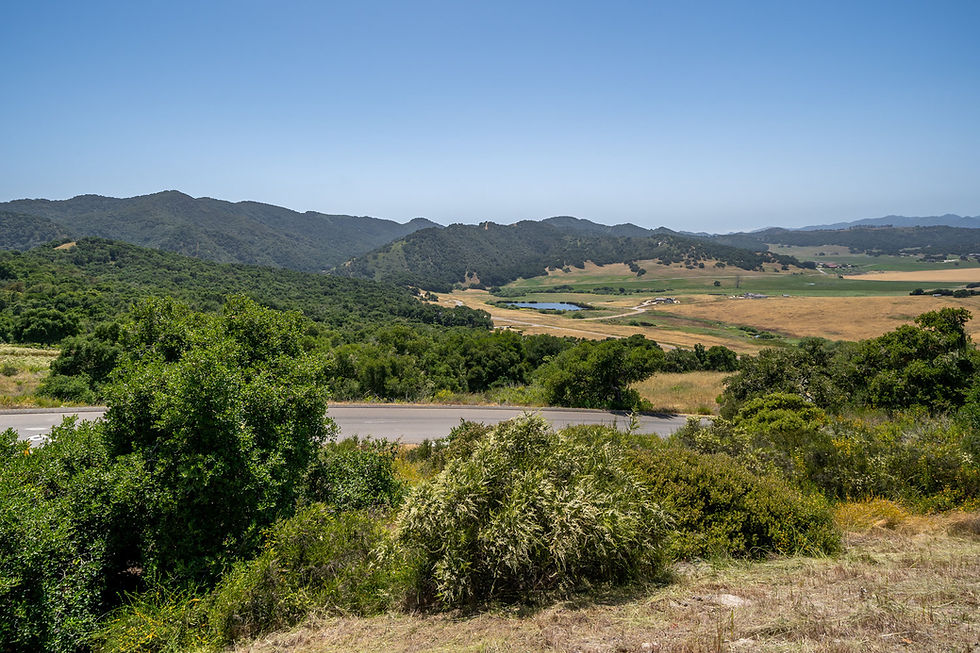
SHARED ROADS · MAINTENANCE AGREEMENTS
Access, easements, and the road you do not own
Acreage often comes with a driveway that crosses someone else's land, a road shared with several neighbors, or a utility line that runs across your field under an easement. These arrangements are normal, and they are usually workable, but they must be understood:
Read the preliminary title report for every easement and get the recorded documents behind each one.
Confirm whether there is a road maintenance agreement and what it obligates you to pay.
Check that legal access actually exists, in writing, and is not just a habit between old neighbors.
Our rural buying post on easements, shared wells, and private roads is the detailed version.
Acreage is not a blank canvas. It is a canvas with the outline already drawn, and the smart buyer reads the outline first.
How to shop for land with a plan
Write down what you want to do on the property in order of importance. Then, for any parcel that interests you, we will pull the zoning, check the water story, review the title report, and look at county permit records. In an afternoon, you will know whether the land supports your list or whether you are buying a different dream than the one you started with.
If the list holds up, we move forward with confidence. If it does not, we keep looking, and there is more acreage across the county than most buyers realize once you know how to read it.

Talk With Kim & Kristen
We are Kim San Jule and Kristen Gentry, Broker Associates with Real Broker, serving San Luis Obispo County and the Central Coast. Whether you are buying, selling, or simply thinking ahead, we are glad to be a resource.
Kim San Jule · Broker Associate, DRE 01948144 · 805-345-8303 · kimsanjule@gmail.com
Kristen Gentry · Broker Associate, DRE 01968754 · 805-441-4618 · kristengentryslo@gmail.com
Real Broker · Search Central Coast homes for sale


